
Mackay Region Housing Strategy 2026-2031
Project update
Council has advanced its commitment to shaping our region’s housing future with the adoption of the Mackay Region Housing Strategy 2026-2031. Click here to view the adopted strategy.
What type of housing meets your current and future needs?
As our lifestyles and circumstances change, so do our housing needs. It is important that our housing options reflect the diversity of lifestyles, preferences and circumstances across our communities.
Suitable housing is foundational to community wellbeing and supports better health, educational outcomes and economic opportunities for residents.
Many factors influence where and how we live — some are shaped by council, while others depend on broader market trends, industry developments and State Government policy.
To support the community in having access to suitable housing, Council has developed the draft Mackay Region Housing Strategy.
How to be involved?
The community plays a vital role in shaping the future of housing in the Mackay region.
As the primary users of housing, residents bring lived experience and local knowledge that can help inform planning decisions.
Council recognises that housing needs vary across life stages, household types and income levels, and community input is essential to ensure our future housing reflects these diverse needs.
Feedback will guide council in aligning planning scheme amendments and policy interventions with the needs of the community and help council support inclusive and liveable communities.
Help us identify what types of dwellings are appropriate and why.
Request a hard-copy survey: Contact council's Community Engagement team via email at engagement@mackay.qld.gov.au or call 1300 MACKAY (622 529).
Consultation closed on October 30, 2025 at 11.59pm.

Stay updated on this project by subscribing to its project update emails. Click the Stay Informed button on this page. You will receive an email afterwards asking you to confirm your subscription.
-
Mackay Region Housing Strategy focuses on lack of local housing diversity
Share Mackay Region Housing Strategy focuses on lack of local housing diversity on Facebook Share Mackay Region Housing Strategy focuses on lack of local housing diversity on X (formerly Twitter) Share Mackay Region Housing Strategy focuses on lack of local housing diversity on Linkedin Email Mackay Region Housing Strategy focuses on lack of local housing diversity link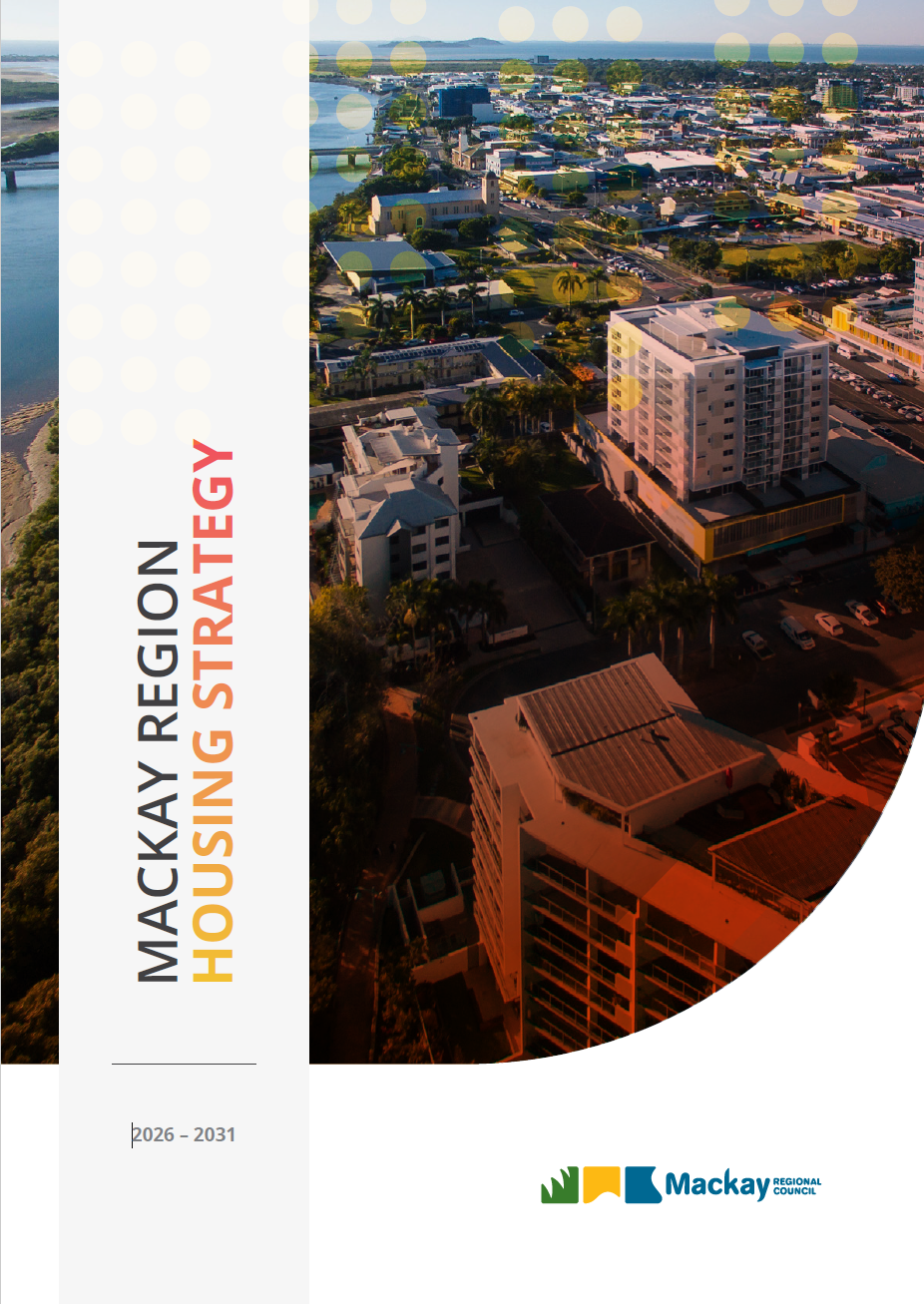
Council has advanced its commitment to shaping our region’s housing future with the adoption of the Mackay Region Housing Strategy 2026-2031.
This strategy, which was adopted at today’s ordinary meeting of council, provides a proactive plan to improve housing diversity, increase the delivery of public and social housing, and accelerate the rate of new housing supply across the region.
The strategy outlines a long‑term plan to ensure the housing delivered in the region meets the changing needs of its residents and supports growth across urban, rural and coastal communities.
Mayor Greg Williamson said the Strategy responds directly to major shifts occurring within the community, with 60 per cent of local households now made up of just one or two people, while only 18 per cent of local dwellings offer one or two bedrooms.
“The mismatch between the homes we have and the homes our residents actually need has never been clearer,” Mayor Williamson said.
“It will be used to guide planning scheme amendments and advocacy priorities.
“We are also determined to support accelerated housing delivery across the region.
“There are about 5000 residential lots that remain undeveloped, a number that has remained above 4000 since 2008.”
Liveability and Social Inclusion Strategic Advisory Committee (LSISAC) Co-Chair Cr Karen May
said a five‑week public consultation period attracted strong community engagement, with residents signalling a clear preference for more diverse and smaller housing options in well‑located areas.
“We have a rapidly ageing population that is contributing to the growing demand for smaller, more accessible homes,” Cr May said.
“Only 33 per cent of households expect their current home will meet their needs in the next 10 to 20 years,” she said. “And the demand for two-bedroom units is expected to double from 16 per cent to 32 per cent.”
“Housing costs have also risen sharply, with detached house prices up 78 per cent and rents up 131 per cent since 2017, which is making it harder and harder for those who are struggling to stay in housing.
“Public and social housing is simply not keeping up with the demand.
“The shortage of social and supported housing is a critical issue, and we’re stepping up our advocacy to the State with the aim of securing a clear delivery target for our region.
“We’ll continue working closely with housing providers and government agencies, so community needs directly shape future investment and land use decisions.”
Between June 2023 and June 2024, only 35 dwellings were added to the region’s public and social housing stock. In the same period, the waiting list for public and social housing in the region grew by 111 households (or 258 persons) to 698 households (or 1144 persons).
LSISAC Co-Chair Cr Ash-Lee Johnson said the strategy outlined nine key actions that council would focus on to improve housing diversity, increase the delivery of public and social housing and accelerate the rate of new housing supply across the region.
“Our Planning Scheme is a key lever we can pull to ensure we encourage a greater mix of housing types,” Cr Johnson said.
“By enabling duplexes, townhouses, units and small‑lot housing in well‑located suburbs, we’re giving residents real choice and ensuring our neighbourhoods grow in a balanced, well‑designed way,” she said.
“To get homes built faster, council is reforming outdated processes, improving industry coordination and aligning infrastructure planning with where growth is actually happening.
“These actions will help bring land to market sooner, reduce bottlenecks and support a stronger, more responsive housing pipeline for our community.”
Mayor Williamson emphasised that housing delivery was a shared responsibility, with outcomes dependent on collaboration between local government, state agencies, developers and community housing providers.
“While council oversees the planning scheme, the construction and delivery of housing rests with industry and government partners,” he said.
Mayor Williamson thanked everyone who had provided their feedback during the consultation phase of the strategy.
“This is a community-informed plan built on real data and real lived experience,” he said. “Residents have been very clear about what they need, and now council is acting.”


-
Mackay Regional Council
Phone 1300 MACKAY (622 529) Email engagement@mackay.qld.gov.au -
Mackay Regional Council

Phone 1300 622 529